
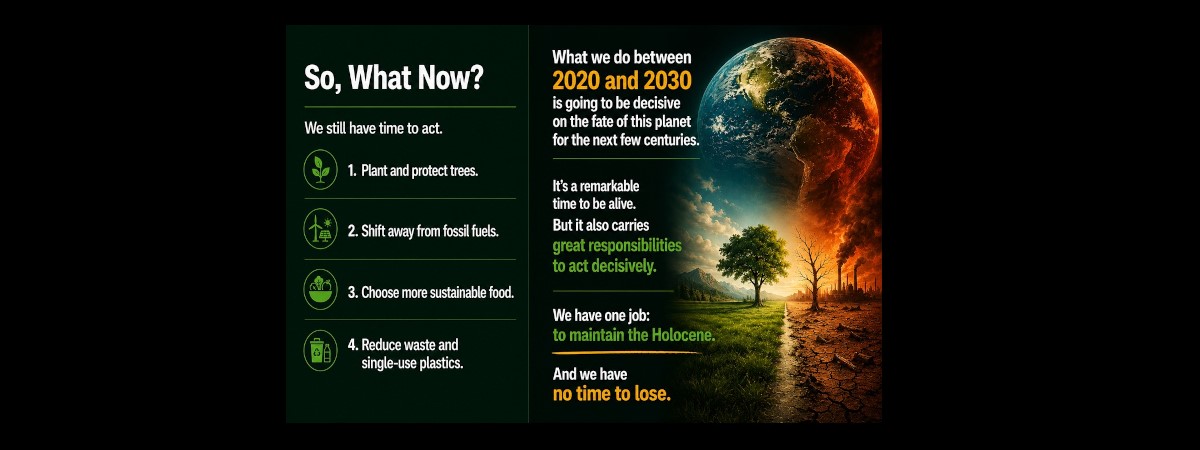

We had one job
For 10,000 years, the Earth balanced its temperature, not exceeding ±1°C. Scientists call it the Holocene. Everything we know, our cities, our food, our seasons, exists because of it.
In just 50 years, we've started breaking it.
At Bhoomi, we recently learnt about this from the Netflix documentary called Breaking Boundaries - the Science of Our Planet. Scientists call these "planetary boundaries." There are nine of them. We've crossed most. Here's where we stand.
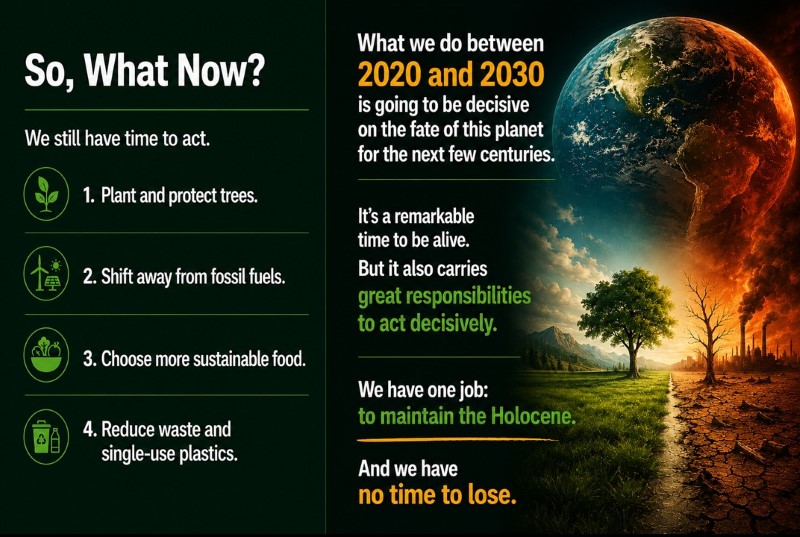
1. Climate Change (Amber turning red soon)
The most talked about. The most ignored.
- CO₂ crossed 350 ppm in 1988. Earth hadn't seen this level in over a million years.
- Today it's at 425 ppm. At 450 ppm, ecosystems collapse in ways we can't reverse.
- 50 years of emissions have undone what took Earth millions of years to stabilize.
2. Biosphere Integrity (Red)
This one doesn't make headlines. But it should.
- Biodiversity isn't just beauty. It's the backbone of clean air, water, and food.
- Losing even one more species tips us dangerously past the safe boundary.
3. Air Pollution (Green)
We've normalised something deeply abnormal.
- Air pollution kills approximately 7 million people every single year.
- On average, it takes 3 years off the life expectancy of every person on Earth.
- You and I are breathing this. Every. Single. Day.
4. Ocean Acidification (Red)
The ocean is absorbing our mess. Quietly. Dangerously.
- More CO₂ in the air means more absorbed by the sea. It becomes increasingly acidic.
- 84% of the world's coral reefs have already suffered bleaching. The worst event ever recorded.
- Coral reefs support nearly a quarter of all marine life. Lose them, entire food chains collapse.
5. Ozone Depletion (Green)
One rare piece of good news. Hold on to it.
- The ozone layer, our shield against harmful UV rays, was being destroyed by chemicals called CFCs.
- A global agreement called the Montreal Protocol phased them out. The ozone layer is slowly healing.
- It's expected to recover to 1980 levels by 2040-2060. Proof that collective action works.
6. Atmospheric Aerosol (Green)
Tiny particles. Huge consequences.
- Dust, vehicle exhaust, industrial smoke scatter sunlight and alter how clouds behave.
- They actually mask some of the warming. If we remove them without cutting CO₂, temperatures spike fast.
- We are unknowingly blaming it as pollution over a much deeper wound.
7. Biogeochemical Flows (Red)
Fertilisers. Fields. Rivers. A slow-moving disaster.
- Excess nitrogen and phosphorus from farming wash into rivers and seas, triggering massive algal blooms.
- These blooms block sunlight, kill underwater plants, which then release more phosphorus as they decay.
- Global nitrogen use has already crossed the safe limit set for the entire planet.
8. Freshwater Use (Amber)
We treat water like it's endless. It isn't.
- We now extract more freshwater from rivers, lakes, and groundwater than the safe planetary limit allows.
- Agriculture (not farmers but everything that surrounds it) is the biggest culprit. Growing food the way we do is quietly draining the planet.
- The water crisis is already here. Just unevenly distributed, for now.
9. Novel Entities (Unknown how Red)
The newest boundary. And the most invisible.
- Over 350,000 synthetic chemicals, plastics, heavy metals, industrial compounds, are now in use worldwide.
- Most have never been tested for their impact on ecosystems or human health.
- We are running a global experiment for disaster. Nobody asked the planet if it agreed.
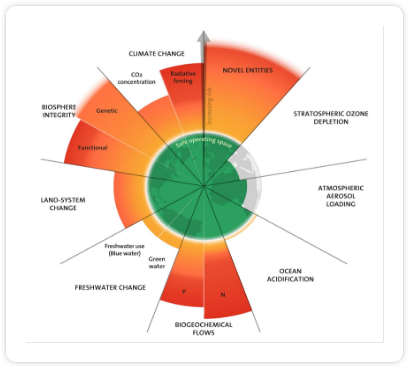
So, What Now?
I don't have all the answers. I'm figuring this out too.
We still have time to act. By changing everyday habits, we can help Earth stay within its safe planetary boundaries.
- Plant more trees in your neighbourhood, restore forests to absorb CO₂ and protect biodiversity.
- Reduce fossil-fuel use and switch to renewable energy like solar and wind.
- Choose healthy, planet-friendly food such as fruits, vegetables, whole grains, legumes, and nuts.
- Reduce waste by avoiding single-use plastics and reusing, recycling, and composting.
What we do between 2020 and 2030 is going to be decisive on the fate of this planet for next few centuries. It’s a remarkable time to be alive. But it also carries great responsibilities to act decisively.
We have one job: to maintain the Holocene. And we have no time to lose.
-----
 Shared by Ashin Paul, Teach for Nature Fellow, 2026 Batch, Bengaluru, Karnataka