
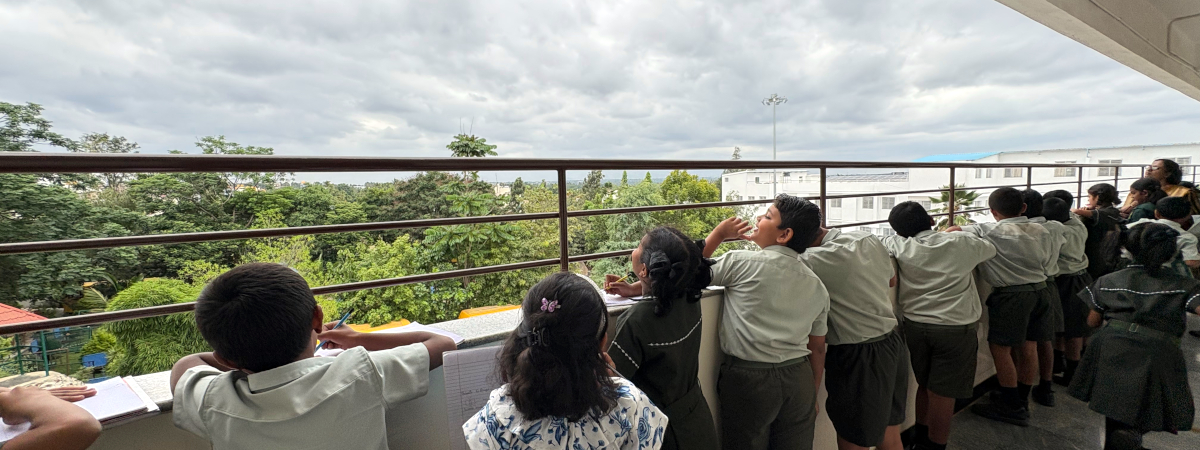

Reimagining the way we learn
Somewhere along the way, learning became separated into boxes
We began placing knowledge into neat compartments - science in one period, mathematics in another, language after lunch, history somewhere before the bell. Nature, too, was assigned its place: a chapter in environmental studies, perhaps a diagram in science, occasionally on awareness day. But the more one sits with the idea of integrating subjects with nature, the more this separation begins to feel strangely artificial.
Because when we step outside, nature does not exist in subjects.
A tree, for instance, refuses categorization. To one person, it may be biology, xylem, phloem, transpiration. To another, mathematics - in branching patterns, angles, symmetry, and fractals. A historian may see movements shaped around forests, resistance, and communities protecting land. A poet sees metaphor. A storyteller sees memory, shelter, longing, or transformation. The tree remains the same, only our lens changes.
Perhaps that is the shift this idea asks of us - not to “add nature” into education, but to recognise that education already emerged from observing the world around us.
Even mathematics, often feared for being abstract and detached, suddenly feels more familiar when encountered outdoors. Patterns begin appearing everywhere: spirals, repetition, rhythm, growth. A simple thought like “a falling leaf is subtraction for the tree but addition for the soil” makes you realise how ideas become easier to understand when they feel alive.
Language, too, feels incomplete without nature. So much of human expression has always leaned on landscapes and seasons to say what ordinary words cannot. Poems, stories, idioms, and songs return repeatedly to rivers, birds, storms, flowers, forests, and mountains. Children often connect more deeply when language grows out of observation - watching, naming, imagining, comparing - rather than only memorising.
What feels most meaningful about integrating subjects with nature is that it quietly changes the way we think about learning itself. It asks us to move away from the idea that knowledge only lives inside textbooks or classrooms. Instead, it invites us to notice, observe, question, and connect.
Maybe children do not always struggle to learn because subjects are difficult. Maybe they struggle because we often present knowledge in pieces, disconnected from the world they actually experience. A child may forget a definition of symmetry, but may remember the shape of a flower they carefully observed. They may forget a lesson on patterns, but notice them again and again in leaves, shells, or branches.
Integrating subjects with nature is not about romanticising outdoor learning or making every lesson happen under a tree. It is about changing the lens. It is about helping children see that the world is already full of questions, stories, numbers, patterns, and histories waiting to be noticed.
Perhaps integrating subjects with nature is not about bringing nature into education at all. Maybe it is about remembering that education was never separate from nature to begin with. Nature is not a subject standing beside others - it is the larger context in which all subjects make sense, connect, and come alive.
-----
 Shared by Shruti Gohil, Teach for Nature Fellow, 2026 Batch, Bangalore, Karnataka