


Lessons from an Ant Trail
The space outside the Bhoomi office is always in a state of flux. Leaves flutter down, flowers bloom and wither, spiders spin delicate webs, and caterpillars munch away at the plants. Yet, amid all this constant change, there’s one thing that remains: the ants. Their trails may shift, weaving new paths around the building, but they are always there. Their presence is unmistakable, a line of life bustling across the pathways, industrious and unwavering.
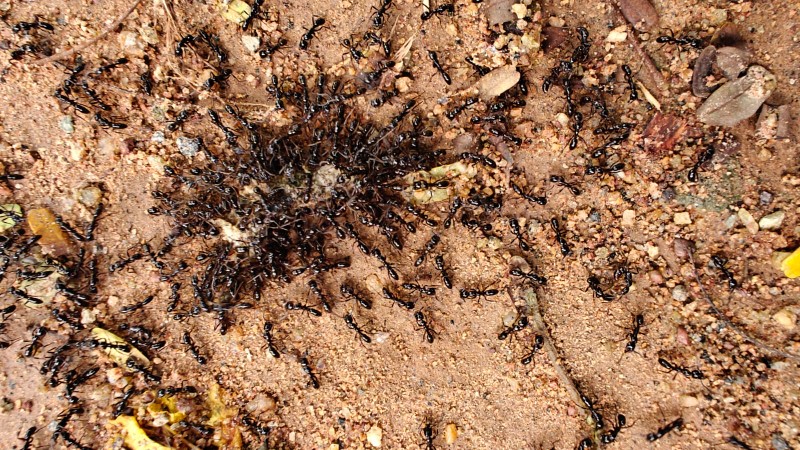
Watching these trails is endlessly intriguing. Sometimes, you’ll see ants on a scouting mission, their tiny antennae waving in search of food. Other times, they form processions, transporting treasures they’ve discovered back to their colony. One recent trail was particularly captivating—these ants, known for forming longer processions, were out hunting for their usual prey: termites. But on this occasion, something unusual caught their attention.
A small, lifeless gecko lay in their path. At first, only a few ants were drawn to the scene, inspecting it with curiosity. Then, as if word had spread through some invisible network, the entire swarm began to converge. Within minutes, the gecko—far larger than any one ant—was in motion, carried by a mass of coordinated, determined workers.
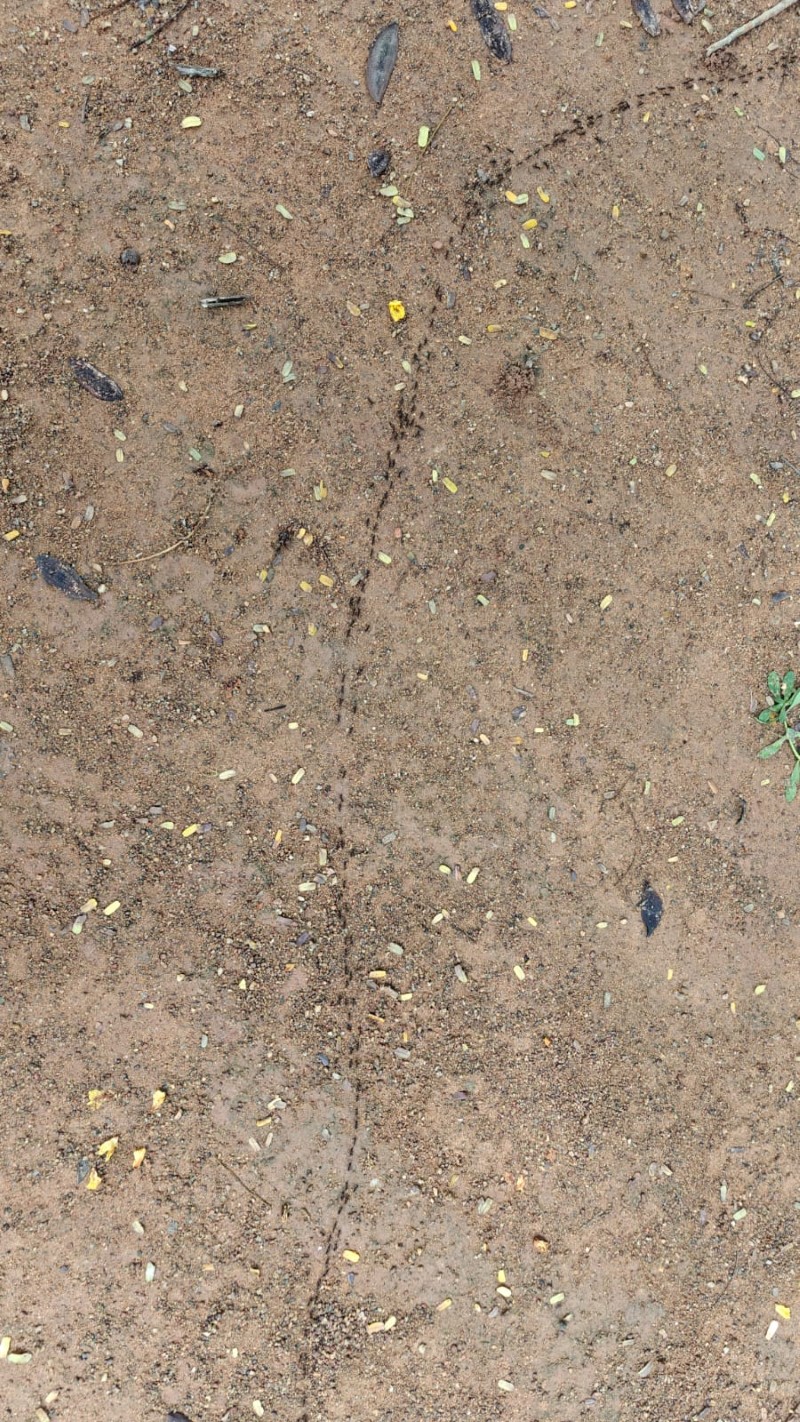
I couldn’t help but wonder how they do it. How do these tiny creatures, each with its own limited view of the world, come together to move something so much bigger than themselves? How do they decide, collectively, to tackle such a task? Would they break the gecko into smaller, more manageable pieces? Or would they transport it whole, a feat of impressive teamwork and coordination? It’s a marvel to witness, and one that sparks endless curiosity.
Researchers call this kind of collective behavior “The Superorganism.” An entire ant colony functions as a single, cohesive unit. Individual ants don’t act solely on their own instincts or goals; instead, they work together as if they were cells in a larger body. Their movements, decisions, and efforts are perfectly synchronized, allowing them to accomplish tasks that would be impossible for any one ant alone.
There’s something almost poetic in their actions. In this tiny world, so easily overlooked, these ants embody the idea of interconnectedness. Their success isn’t based on the strength of a single individual but on their ability to collaborate and communicate as a group. They remind us of the power of community—how much more we can achieve when we work together towards a common goal, each playing a small but vital role in the grander scheme.
As I watch them carry the gecko away, I am filled with a quiet sense of wonder. In this seemingly simple, everyday scene, there are hidden layers of complexity and mystery, waiting to be unraveled. It’s a reminder that nature, in all its forms, holds lessons for those who take the time to observe, question, and reflect.
-----
 Jayarakesh, Nature Educator & Mentor, Teach for Nature