

Designing Learning, One Lesson at a Time
The Invisible Work Behind Every Classroom
Every Friday evening, when I was excited for the weekend and getting ready to leave school, I used to notice my teachers sitting with their special notebooks, writing page after page. My friends and I would joke that it was their homework. Little did I know that I would someday be doing my own "teacher's homework."
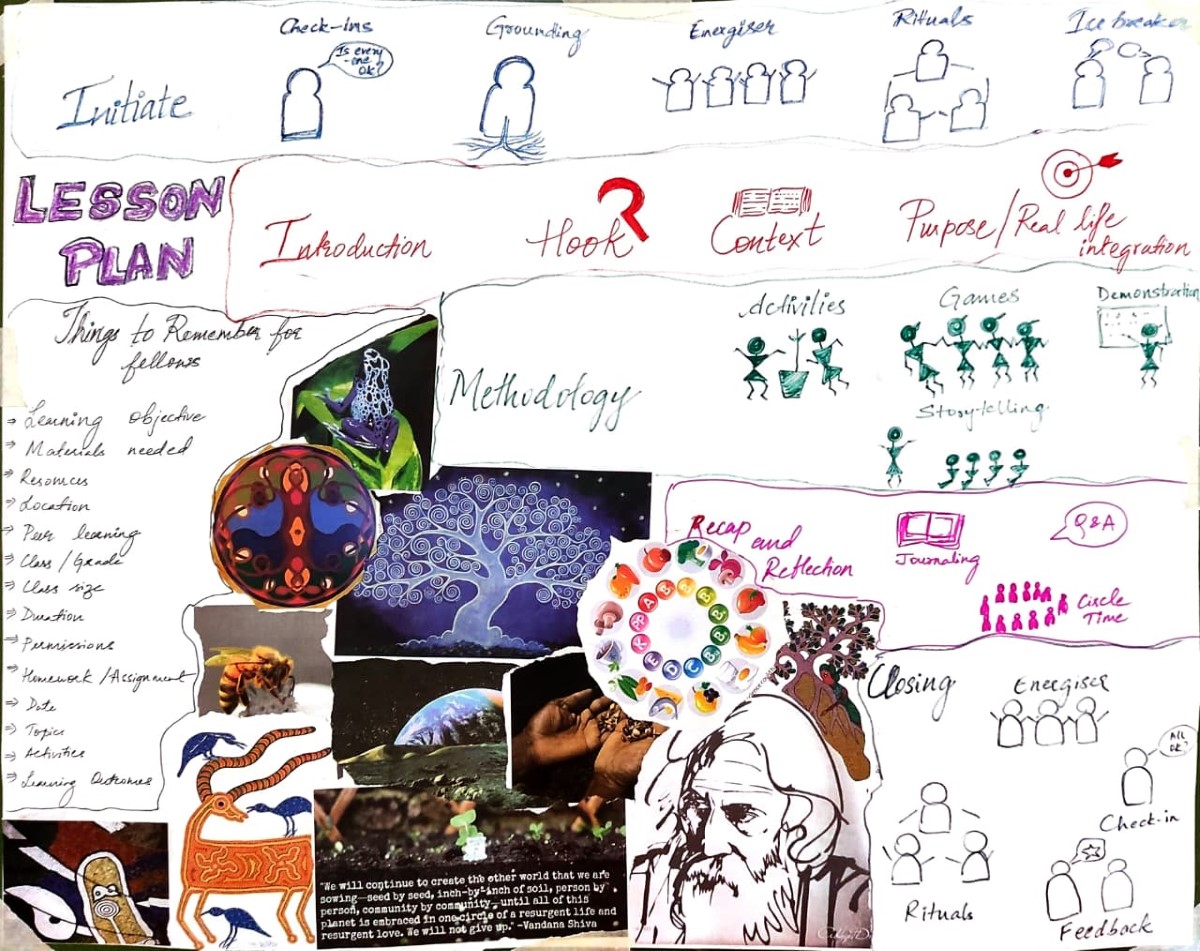
What I once called "teacher's homework" I now know as a lesson plan, thanks to Bhoomi's Teach for Nature fellowship orientation. I signed up to become a nature educator because I strongly believe children should grow up with nature and experience the same wonders I have been fortunate to witness in the natural world.
During my time at Bhoomi, I created three lesson plans, each with a different theme and designed for a different age group.
My first lesson plan was about Commercial Farming, aimed at exploring how large-scale monoculture farms both ensure food security and threaten local ecosystems.
One of the biggest lessons I learned was that teaching doesn't happen in isolated sessions. Lessons are connected. A topic has to be introduced gradually, with each class adding another layer so learners can unpack different perspectives over time. Every lesson plan therefore needs a structure—not just for a single class, but for how the learning journey unfolds across consecutive sessions.
As a software user experience designer, I already appreciated the importance of clarity in communication and thoughtful delivery. Those skills came in handy when I started designing my next lesson plans with many more tools at my disposal.
Our facilitators from Nature Classrooms, Vena and Priyanka, introduced us to a framework for bringing nature into classrooms. They encouraged us to make our lessons:
- Nature-centric
- Contextual
- Culturally relevant
- Age-appropriate
- Learner-centric
- Experiential
- Inquiry-based
- Empathetic
- Inclusive and accessible
- Well-being focused
Alongside these ten pedagogical principles, we also explored Howard Gardner's Multiple Intelligences to better understand how different children learn:
- Naturalist
- Visual-spatial
- Logical-mathematical
- Bodily-kinesthetic
- Interpersonal
- Intrapersonal
- Musical-rhythmic
- Verbal-linguistic
We also had facilitators who showed us how storytelling, movement, and theatre could become powerful tools for taking nature into classrooms.
All of this helped me approach my next two lesson plans much more mindfully—and, in many ways, magically.
The next lesson plan I created was Living Soil for fourth-standard children. I consciously incorporated many of the Nature Classrooms principles, Multiple Intelligences, and the other tools we had learned.
After designing the lesson, I had to present it in a pretend classroom with my co-fellows. Preparing for my very first classroom demonstration was incredibly exciting. I walked around the Bhoomi campus collecting different soil samples and even found some earthworms for a live demonstration. I also remembered something friends from my farming community had shown me: filling a glass jar with soil and water to observe how the different layers—sand, silt, and clay—settle over time. It was such a visual and experiential way of understanding soil that I decided to include it in my class.
The session went well, and I received encouraging feedback about my classroom management.
I was also reminded to keep it simple. Rather than packing multiple activities into one session, it is often better to focus on one engaging experience. I realised that experiential learning alone can hold children's attention remarkably well. Sometimes it is more effective to bring resources into the classroom than ask children to collect them themselves.
By the end of the session, I had gained confidence that I could do this with actual schoolchildren.
My third lesson plan was a Nature Walk for fourth graders.
This time, I remembered our nature educator Jaya Rakesh's advice: if you're taking children outdoors, always visit the place a day or two in advance. Observe what is around, identify interesting things to notice, and prepare a rough plan for the experience.
I also chose to begin with a story about a girl returning home from school while noticing the nature around her. For fourth-standard children, I felt a story would be a much more engaging introduction to the idea of a nature walk than simply explaining it.
During my recce around the Bhoomi campus, I chose the Touch-Me-Not (sensitive plant) as the highlight because it appeared in my story. Thankfully, I found several patches across the campus.
The classes were designed for forty minutes. Apart from introducing the sensitive plant, I intentionally allowed the rest of the walk to emerge naturally.
And, oh boy, it did.
We discovered helicopter seeds spinning through the air, admired a spider sitting in its sprawling web, and explored many observations through inquiry-based discussions.
During the walk, I also had to handle an unexpected situation. Two of my pretend students started scuffling with each other, disrupting everyone else's experience. In that moment, I lost my ability to manage the class and broke character.
Reflecting on it later, I realised something important: I need to be careful not to have favourites among my learners.
Looking back, creating lesson plans completely changed how I see teachers' work. I now understand how much thinking, preparation, and intentionality go into every class. It also strengthened my belief that teachers deserve to be paid fairly for the invisible work that happens long before they step into a classroom.
More importantly, I found a renewed sense of gratitude for the teachers I still remember today—not because they completed the syllabus, but because of the unique ways they taught that truly reached me.
As I prepare to begin teaching in schools, I'm now creating lesson plans a week in advance and sharing them with my mentor and Teach for Nature's Program Director, Ishita, for feedback.
I'm deeply grateful to have such a supportive learning community at Bhoomi—one that is invested not only in my growth as a facilitator, but also in ensuring every learner gets the very best from my classroom.
-----
 Shared by Surya, Teach for Nature Fellow, 2026 Batch, Salem, Tamil Nadu